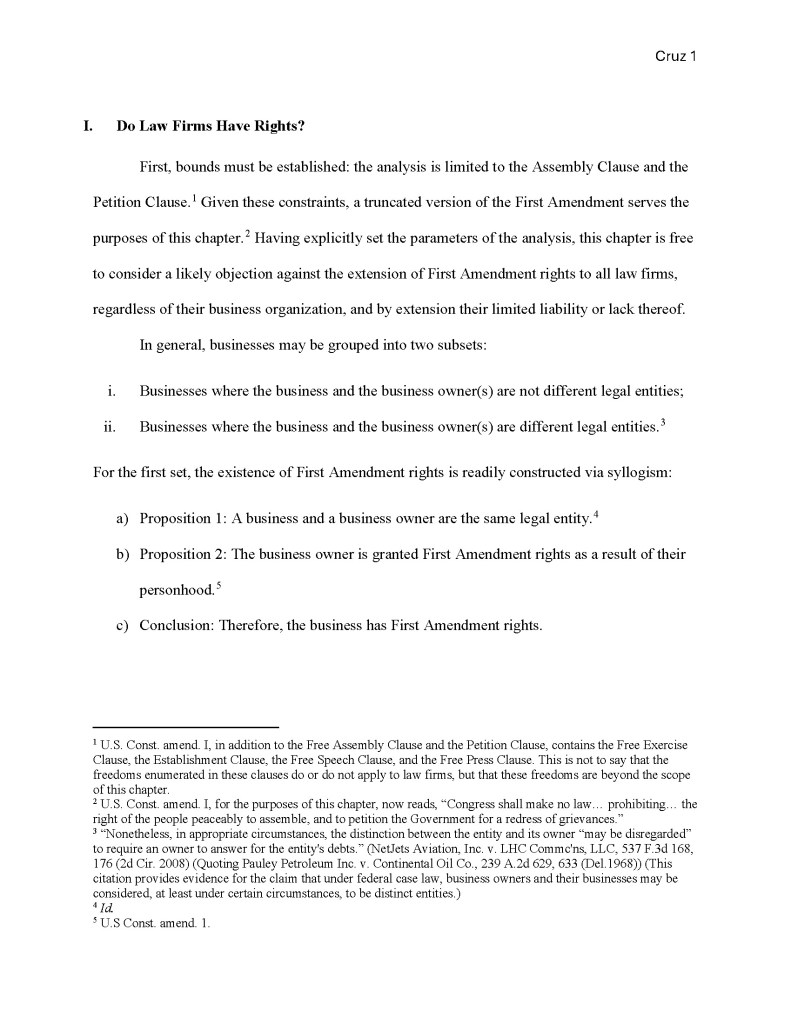
First, bounds must be established: the analysis is limited to the Assembly Clause and the Petition Clause.[1] Given these constraints, a truncated version of the First Amendment serves the purposes of this chapter.[2] Having explicitly set the parameters of the analysis, this chapter is free to consider a likely objection against the extension of First Amendment rights to all law firms, regardless of their business organization, and by extension their limited liability or lack thereof.
In general, businesses may be grouped into two subsets:
- Businesses where the business and the business owner(s) are not different legal entities;
- Businesses where the business and the business owner(s) are different legal entities.[3]
For the first set, the existence of First Amendment rights is readily constructed via syllogism:
- Proposition 1: A business and a business owner are the same legal entity.[4]
- Proposition 2: The business owner is granted First Amendment rights as a result of their personhood.[5]
- Conclusion: Therefore, the business has First Amendment rights.
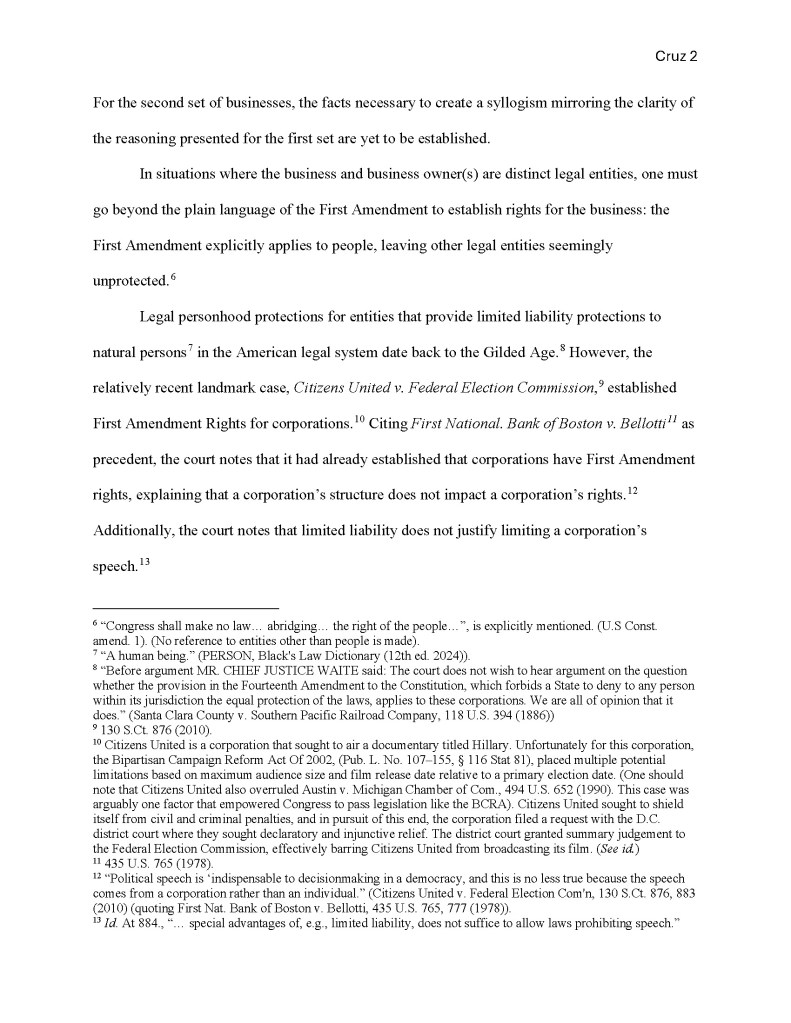
For the second set of businesses, the facts necessary to create a syllogism mirroring the clarity of the reasoning presented for the first set are yet to be established.
In situations where the business and business owner(s) are distinct legal entities, one must go beyond the plain language of the First Amendment to establish rights for the business: the First Amendment explicitly applies to people, leaving other legal entities seemingly unprotected.[6]
Legal personhood protections for entities that provide limited liability protections to natural persons[7] in the American legal system date back to the Gilded Age.[8] However, the relatively recent landmark case, Citizens United v. Federal Election Commission,[9] established First Amendment Rights for corporations.[10] Citing First National. Bank of Boston v. Bellotti[11] as precedent, the court notes that it had already established that corporations have First Amendment rights, explaining that a corporation’s structure does not impact a corporation’s rights.[12] Additionally, the court notes that limited liability does not justify limiting a corporation’s speech.[13]
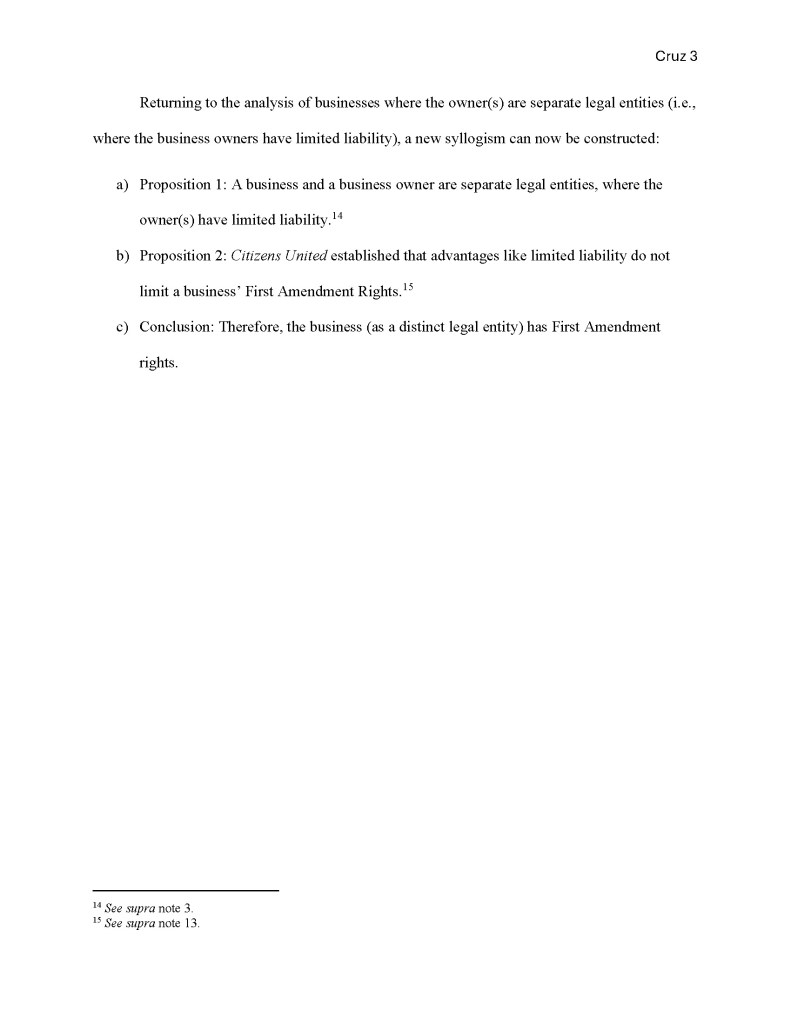
Returning to the analysis of businesses where the owner(s) are separate legal entities (i.e., where the business owners have limited liability), a new syllogism can now be constructed:
- Proposition 1: A business and a business owner are separate legal entities, where the owner(s) have limited liability.[14]
- Proposition 2: Citizens United established that advantages like limited liability do not limit a business’ First Amendment Rights.[15]
- Conclusion: Therefore, the business (as a distinct legal entity) has First Amendment rights.
[1] U.S. Const. amend. I, in addition to the Free Assembly Clause and the Petition Clause, contains the Free Exercise Clause, the Establishment Clause, the Free Speech Clause, and the Free Press Clause. This is not to say that the freedoms enumerated in these clauses do or do not apply to law firms, but that these freedoms are beyond the scope of this chapter.
[2] U.S. Const. amend. I, for the purposes of this chapter, now reads, “Congress shall make no law… prohibiting… the right of the people peaceably to assemble, and to petition the Government for a redress of grievances.”
[3] “Nonetheless, in appropriate circumstances, the distinction between the entity and its owner “may be disregarded” to require an owner to answer for the entity’s debts.” (NetJets Aviation, Inc. v. LHC Commc’ns, LLC, 537 F.3d 168, 176 (2d Cir. 2008) (Quoting Pauley Petroleum Inc. v. Continental Oil Co., 239 A.2d 629, 633 (Del.1968)) (This citation provides evidence for the claim that under federal case law, business owners and their businesses may be considered, at least under certain circumstances, to be distinct entities.)
[4] Id.
[5] U.S Const. amend. 1.
[6] “Congress shall make no law… abridging… the right of the people…”, is explicitly mentioned. (U.S Const. amend. 1). (No reference to entities other than people is made).
[7] “A human being.” (PERSON, Black’s Law Dictionary (12th ed. 2024)).
[8] “Before argument MR. CHIEF JUSTICE WAITE said: The court does not wish to hear argument on the question whether the provision in the Fourteenth Amendment to the Constitution, which forbids a State to deny to any person within its jurisdiction the equal protection of the laws, applies to these corporations. We are all of opinion that it does.” (Santa Clara County v. Southern Pacific Railroad Company, 118 U.S. 394 (1886))
[9] 130 S.Ct. 876 (2010).
[10] Citizens United is a corporation that sought to air a documentary titled Hillary. Unfortunately for this corporation, the Bipartisan Campaign Reform Act Of 2002, (Pub. L. No. 107–155, § 116 Stat 81), placed multiple potential limitations based on maximum audience size and film release date relative to a primary election date. (One should note that Citizens United also overruled Austin v. Michigan Chamber of Com., 494 U.S. 652 (1990). This case was arguably one factor that empowered Congress to pass legislation like the BCRA). Citizens United sought to shield itself from civil and criminal penalties, and in pursuit of this end, the corporation filed a request with the D.C. district court where they sought declaratory and injunctive relief. The district court granted summary judgement to the Federal Election Commission, effectively barring Citizens United from broadcasting its film. (See id.)
[11] 435 U.S. 765 (1978).
[12] “Political speech is ‘indispensable to decisionmaking in a democracy, and this is no less true because the speech comes from a corporation rather than an individual.” (Citizens United v. Federal Election Com’n, 130 S.Ct. 876, 883 (2010) (quoting First Nat. Bank of Boston v. Bellotti, 435 U.S. 765, 777 (1978)).
[13] Id. At 884., “… special advantages of, e.g., limited liability, does not suffice to allow laws prohibiting speech.”
[14] See supra note 3.
[15] See supra note 13.
The same text, formatted in accordance with law review bluebook standards, is found below:
 Carlos Cruz: Writing Samples
Leave a comment